A new AI tool ships every hour. I'm barely exaggerating. New models, new vendors, new patterns, new methodologies, new ways to do absolutely everything. It's the 2018-19 era, when a JavaScript framework shipped every week, times ten.
You can't keep up. It's not that you're slow: it's physically impossible. Trying leaves you with one thing, the permanent sense of being behind. FOMO. And its ugly cousin, fatigue: the exhaustion of trying to stay current with something that never stops. AI fatigue is real, and you're the one who pays for it.
Fear kills learning
When you're trying to learn something as consequential as using AI professionally, the last thing you need is fear. Fear is the opposite of curiosity. Start out believing you're already behind and it's like running a race from 300 meters back: you make it ten times harder on yourself before your first stride.
Neither resistance nor passive acceptance
The trap is thinking there are only two ways out: resist it or swallow all of it. Both are bad.
Resisting, at this point, is absurd. A year and a half after the boom, if you're not using this, you're already late. But passive acceptance, picking at every model and every tool that appears, is just as absurd.
The way out is to go all in. And I mean it, because this rarely happens. To me it's on the level of getting access to the internet. The internet democratized knowledge; AI just democratized execution, however much that annoys a certain elitist engineer. What's left as a real edge is something else, but ignoring the shift is not an option.
All in isn't wide, it's deep
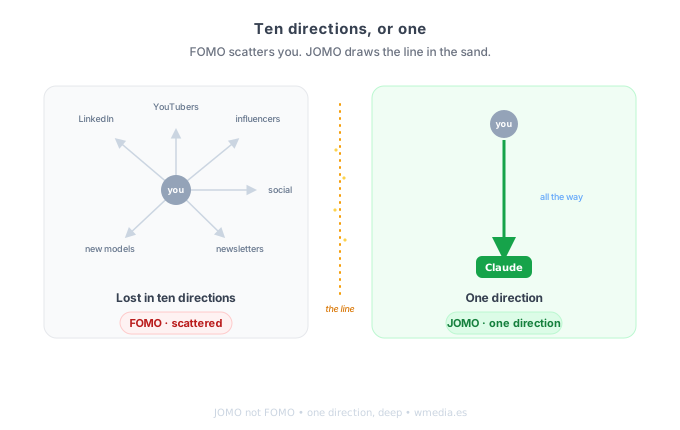
All in isn't wide, it's deep. Going all in by sampling ten tools at once is still drinking from the firehose. That's FOMO with a different name.
Going all in for real means going to the bottom of one direction. Attention that runs deep like a river, not wide and shallow like a swamp.
JOMO is exactly that: the joy of missing out on what doesn't matter. It's not disconnecting from AI, it's disconnecting from the noise of AI so you can go deep on what you actually chose. You draw a line in the sand and, for a while, you ignore everything else.
How I do it
Let me tell you how I do it, pragmatically and without the posturing. I chose Claude, partly out of affinity for Anthropic as a brand, and Claude Code as my main harness, the one I use every day. It's good enough for what I need, so I stopped looking.
I know OpenCode is excellent. I tried it, I wanted to keep going, and I cancelled the subscription because I don't have the bandwidth for two. I know Codex is, in some respects, better than Claude; I genuinely believe that. But I can't carry both. You have to choose.
The uncomfortable part, plainly: I chose, on purpose, the tool that may not be the best. Because good enough and committed beats optimal and scattered. The cost of switching, comparing, and reconfiguring every week eats any marginal edge of this week's model. Depth in one, not crumbs from ten.
It's not just the tool, it's the information diet
It's not only which tool you choose, it's what information you consume. That's the other half, and almost nobody minds it.
I cut social media to almost zero, especially at the start. My diet for Anthropic and Claude is short: the Anthropic engineering blog, the Claude Code blog, its changelog, and its docs. That's it. That gives you months, or years, of depth ahead. You need nothing else at the documentation level until you understand, master, and wring out all of that.
The rest (this week's thread, this week's launch, this week's "this changes everything") you miss. On purpose. With joy.
Where this comes from
By the way, I didn't invent this. JOMO over FOMO is 37signals' principle number 29: "Life's better when you're missing the stuff that doesn't matter anyway." I read it a long time ago and it stuck. 37signals was founded by David Heinemeier Hansson and Jason Fried, and I'm a big fan of how they think. The only thing that's mine here is applying that old idea to this particular AI moment.
Closing
One last thing. Once you have your tool and your minimal diet, the most important part is still missing: applying it to a problem. And not just any problem, yours. Scratch your own itch. But that's material for another day.
For now, take this with you: don't try to keep up with AI. Go all in, but in one direction, deep. And enjoy missing everything else.