TL;DR Claude Code just shipped a new toggle (
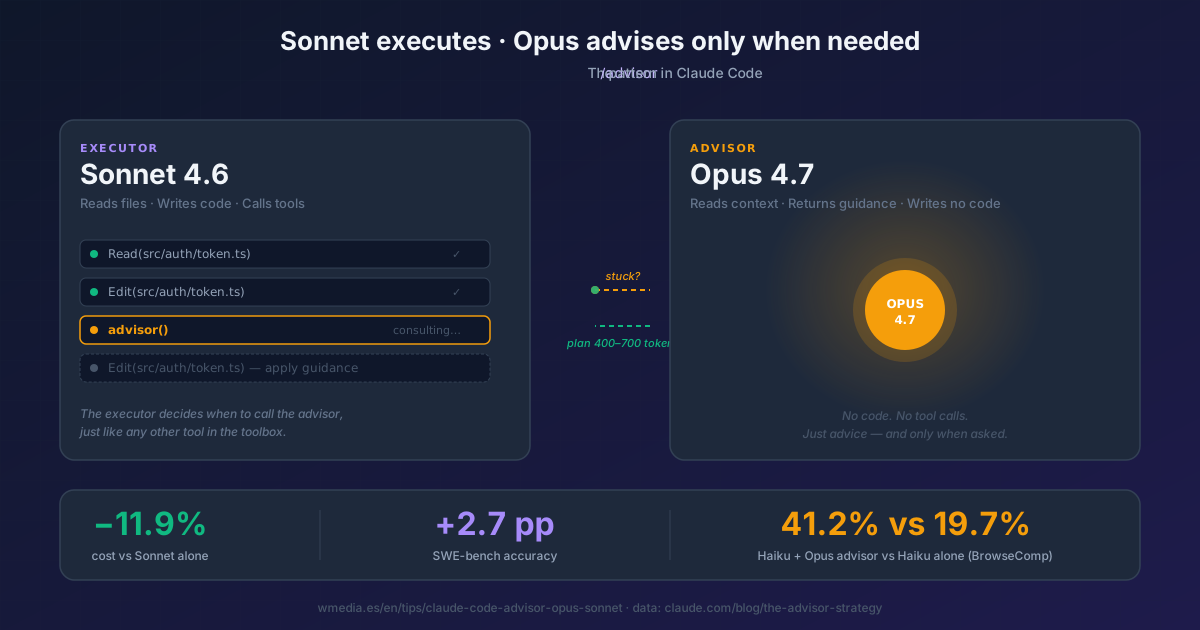
/advisor) that lets you run Sonnet as your main engine and consult Opus only when Sonnet stalls. Anthropic measured the combo: −11.9% cost and +2.7% accuracy on SWE-bench vs Sonnet alone. With Haiku + Opus advisor the jump is even bigger: 41.2% vs 19.7% on BrowseComp. You pay Sonnet prices 90% of the time; Opus only shows up when it actually matters.
How it works
It's not a model swap or a classic orchestration. It's a player + coach pattern:
- The executor (Sonnet or Haiku) does ALL the real work — reads files, writes code, calls tools, responds to you
- The advisor (Opus 4.7 or Sonnet 4.6) stays on the bench as just another tool in the executor's toolbox
- When the executor hits a decision it can't solve (an ambiguous bug, a complex refactor, or simply "circling without progress"), it calls the advisor like it would call Bash
- The advisor reads the full shared context and returns a plan or correction in 400–700 tokens — no code, no tool calls, just guidance
- The executor takes that advice and resumes work
The analogy: a junior dev with the senior's number on speed dial. The junior writes everything, only calls when stuck, and the senior never touches the keyboard.
What you'll see when you type /advisor
Advisor Tool

When Claude needs stronger judgment — a complex decision, an
ambiguous failure, a problem it's circling without progress — it
escalates to the advisor model for guidance, then resumes. The
advisor runs server-side and uses additional tokens.

For certain workloads, pairing Sonnet as the main model with Opus
as the advisor gives you near-Opus performance with reduced token
usage.

  1. Opus 4.7
  2. Sonnet 4.6
> 3. No advisor ✓

Enter to confirm · Esc to cancel
How to activate it
1. Type /advisor in any Claude Code session. Default is No advisor — you opt in manually.
2. Pick an advisor:
- Opus 4.7 if your executor is Sonnet 4.6 — the mainstream combo Anthropic recommends
- Sonnet 4.6 if your executor is Haiku 4.5 — doubles Haiku's capability with minimal extra cost
- No advisor to turn it off
3. Enter. The advisor is live for the session. Sonnet keeps doing everything — it only escalates when it needs to.
4. You don't invoke anything manually. The executor decides when to consult based on its own uncertainty. You can nudge via prompt ("if you see anything suspicious, consult the advisor before touching code").
When it pays off (and when it doesn't)
Turn the advisor on when:
- You're on a long task with many decisions (refactor, migration, complex feature)
- Sonnet is failing on a specific thing and you've already tried several times
- You're about to ship something critical (payments, auth, migrations) and want a second opinion in-flight
Don't turn it on when:
- You're doing CRUD, boilerplate, or renames — extra tokens, no return
- You're already using Opus 4.7 as executor — no point consulting itself
- You're in pure
/planmode — for that useopusplan, which is a different strategy
Recommended combos
| Executor | Advisor | When |
|---|---|---|
| Sonnet 4.6 | Opus 4.7 | The practical default — Opus quality at Sonnet cost |
| Haiku 4.5 | Opus 4.7 | For long-running exploration and heavy code reads |
| Haiku 4.5 | Sonnet 4.6 | Cheaper still, useful when you just need an occasional nudge |
| Opus 4.7 | (anything) | Doesn't make sense — Opus is already the most capable model |
The numbers Anthropic published
| Metric | Number |
|---|---|
| Cost reduction (Sonnet + Opus advisor vs Sonnet alone) | −11.9% |
| SWE-bench Multilingual accuracy delta | +2.7 pp |
| Haiku + Opus advisor on BrowseComp | 41.2% (Haiku alone: 19.7%) |
| Advisor tokens per consultation | 400–700 (1,400–1,800 with thinking) |
The number that closes the argument: Haiku with Opus as advisor doubles its BrowseComp score. That's not a marginal gain — that's consulting the big model at the precise moment it's needed and not the rest of the time.
Reference
| Field | Value |
|---|---|
| Command | /advisor |
| Available advisors | Opus 4.7, Sonnet 4.6 |
| Default | No advisor (opt-in) |
| Execution | Server-side |
| Extra tokens per consultation | 400–700 (plan) · 1,400–1,800 (with thinking) |
| Invocation | The executor decides when to consult |
| API beta header | advisor-tool-2026-03-01 |
| Source | Anthropic Advisor Strategy (April 9, 2026) |
It's the third major April change in Claude Code, after Opus 4.7 and /ultrareview. All three move in the same direction: delegate more, supervise less, pay only for the horsepower you actually use.
Official docs: The advisor strategy — Anthropic · Advisor tool (API)