TL;DR Opus 4.7 landed this morning (April 16, 2026) in Claude Code and it changes the game:
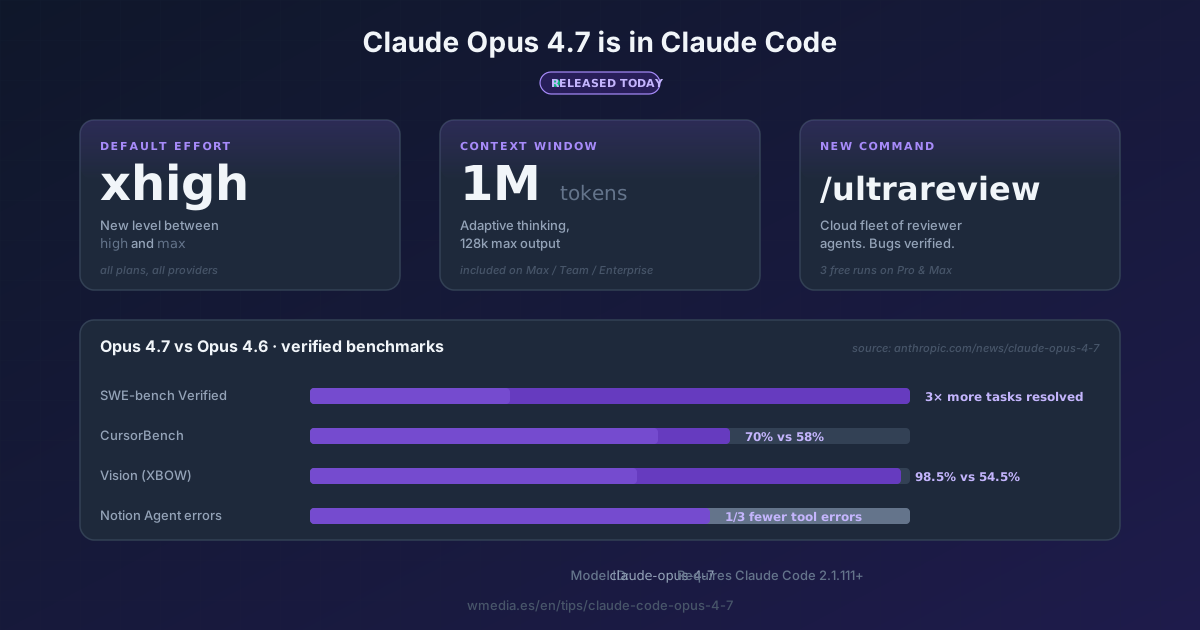
xhigheffort by default, 1M-token context window, adaptive reasoning, and the new/ultrareviewcommand. Max users get it as default; Pro users have to switch with/model opus. It's the first model you can actually hand a multi-hour task to without checking in every ten minutes to fix it.
How it works
Opus 4.7 replaces Opus 4.6 as Anthropic's most capable model. In Claude Code it introduces three visible changes from the first prompt: effort level xhigh by default (a new step between high and max), adaptive reasoning (the model decides how much to think on its own), and a 1M-token context window enabled with no configuration on Max, Team, and Enterprise.
The agentic jump is where it matters. Anthropic reports 3× more tasks resolved on SWE-bench Verified vs Opus 4.6, 70% on CursorBench (vs 58%), and a third fewer tool errors on Notion Agent benchmarks. On vision, 98.5% vs 54.5% — that's not an improvement, it's a different model.
It also reports better cross-session memory: start a long task, close your session, come back the next day, and it picks up without you having to re-explain a thing. It extends the automatic memory Claude Code already had between conversations into multi-hour work.
What you'll see when you start a session
$ claude --version
2.1.111

$ /model
> opus   ─ Claude Opus 4.7 (xhigh)
  sonnet ─ Claude Sonnet 4.6 (high)
  haiku  ─ Claude Haiku 4.5

✔ opus selected. Effort: xhigh
How to start using it
1. Update to 2.1.111 or later. Opus 4.7 doesn't show up in earlier versions:
claude update
claude --version   # should show 2.1.111+
2. Select the model. If you're on Max or Team Premium, Opus 4.7 is already your default. On Pro, API, and Enterprise plans, Sonnet 4.6 remains default until April 23, 2026 — switch manually until then:
/model opus
3. Leave effort at xhigh. It's the new default on Opus 4.7 across all plans and the level Anthropic recommends for agentic coding tasks. Drop to high only when you want more speed and fewer tokens; bump to max only for occasional problems where deep reasoning pays off (warning: max is prone to overthinking).
4. Take advantage of the 1M context. On Max, Team, and Enterprise, the 1 million tokens are enabled out of the box. To force it explicitly:
/model opus[1m]
5. Review before merge with /ultrareview. The new command spins up a fleet of reviewer agents in the cloud to verify real bugs — not style suggestions. Three free runs on Pro and Max. And if you want full delegation without confirming every step, pair it with permission modes in acceptEdits or auto.
6. If you'd rather pay less: set Opus 4.7 as advisor. The /advisor toggle keeps Sonnet 4.6 executing and consults Opus 4.7 only when Sonnet stalls. Anthropic measured −11.9% cost and +2.7% accuracy vs Sonnet alone.
Reference
| Field | Value |
|---|---|
| Model ID | claude-opus-4-7 |
| Claude Code alias | opus |
| Minimum Claude Code version | 2.1.111 |
| Context window | 1M tokens |
| Max output | 128k tokens |
| Pricing | $5/MTok input · $25/MTok output |
| Thinking | Adaptive (not Extended) |
| Default effort | xhigh |
| Effort levels | low, medium, high, xhigh, max |
| Training cutoff | January 2026 |
| Default model on | Max, Team Premium |
When Sonnet still makes sense
Opus 4.7 isn't always the answer. Sonnet 4.6 handles 80% of daily coding work cheaper and faster — and the right model depends on the task. Reserve Opus 4.7 for: deep debugging, large refactors, long sessions with heavy context, and anything that used to force you to babysit every 15 minutes. For CRUD and boilerplate, stick with Sonnet. And since June there's a new tier above Opus: Fable 5, for your longest and hardest tasks.
Official docs: Models overview · Introducing Claude Opus 4.7 · Model configuration