TL;DR
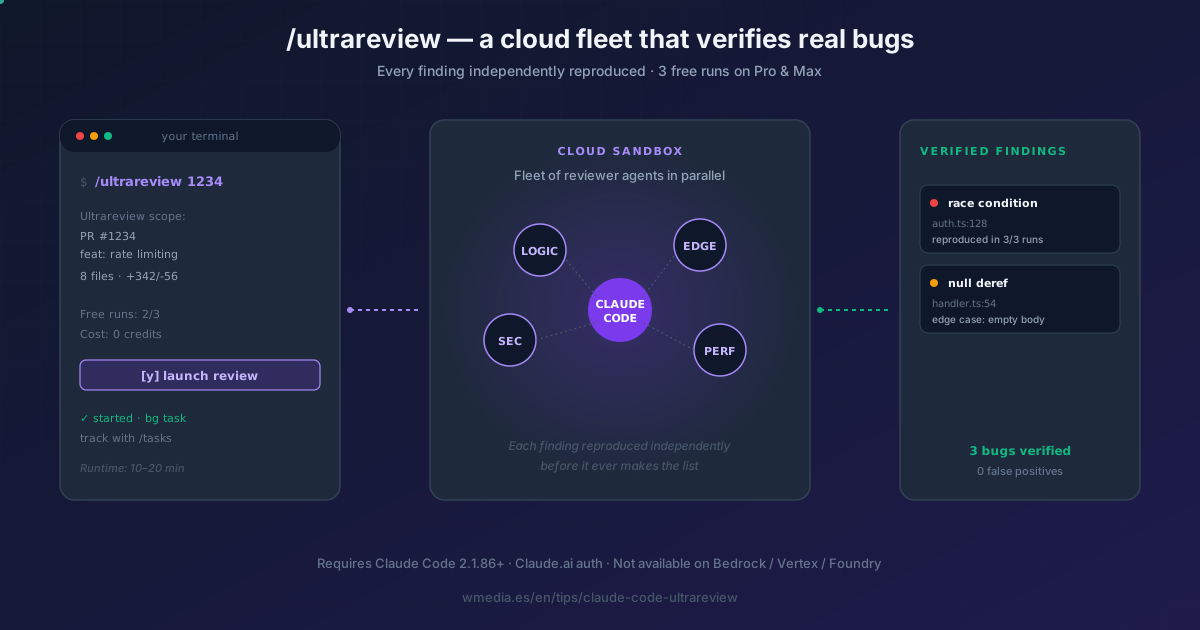
/ultrareviewis a new Claude Code command that launches a fleet of reviewer agents in the cloud to hunt for bugs before you merge. Every finding is independently reproduced and verified — no "you might want to use const" noise. Three free runs on Pro and Max, and the whole thing runs in the background while you keep working.
How it works
/ultrareview landed in Claude Code on April 16, 2026 alongside Opus 4.7 — it's one of the big changes in that launch.
When you run it, Claude Code uploads your branch state (or clones your GitHub PR if you pass a number) to the same cloud infrastructure it already uses for remote sessions, and orchestrates multiple reviewer agents in parallel. Each one explores the change from a different angle: logic, edge cases, security, performance. What separates /ultrareview from local /review is that every finding is independently reproduced before being reported. If the bug can't be verified, it doesn't make the list.
It's the equivalent of putting a paranoid senior on your diff for 15 minutes with nothing else to do.
What you'll see when it kicks off
$ /ultrareview 1234

Ultrareview scope:
  PR #1234 — feat: add rate limiting middleware
  Files changed: 8 · Lines: +342 / -56

Free runs remaining: 2/3
Estimated cost: 0 credits (within free runs)

[Confirm to launch review in background? y/n]

✔ Review started. Track with /tasks
How to use it
1. Update Claude Code to 2.1.86 or later and authenticate with a Claude.ai account (it won't work with an API key alone):
claude update
/login
2. Review your current branch vs the default branch — includes uncommitted and staged changes:
/ultrareview
3. Review a specific GitHub PR (requires a github.com remote on the repo):
/ultrareview 1234
4. Track the review in the background. It takes 10–20 minutes and doesn't block your session. You can close Claude Code and come back later — the task keeps running:
/tasks # see running and completed reviews
5. When it finishes, verified findings arrive with file, line, and explanation. Ask Claude to fix them directly from the results.
/review vs /ultrareview
The comparison to have clear before picking one:
| Criterion | /review |
/ultrareview |
|---|---|---|
| Execution | Local, in your session | Cloud sandbox |
| Depth | Single pass | Multi-agent fleet with independent verification |
| Duration | Seconds to minutes | 10–20 minutes |
| Cost | Counts toward normal usage | 3 free runs, then extra usage |
| Best for | Fast feedback while iterating | Pre-merge confidence on substantial changes |
Note: the local command is now /code-review (it reviews your diff before the PR, with --fix and --comment); /ultrareview is its cloud version, also callable as /code-review ultra.
Reference
| Field | Value |
|---|---|
| Command | /ultrareview [PR] |
| Minimum version | Claude Code 2.1.86 |
| Authentication | Claude.ai (API key alone doesn't work) |
| Plans with free runs | Pro and Max · 3 runs, one-time |
| Team and Enterprise | No free runs, billed as extra usage |
| Not available on | Bedrock, Vertex AI, Foundry, organizations with Zero Data Retention |
| Tracking | /tasks |
| Without arguments | Diffs current branch vs default branch (includes uncommitted) |
| With PR number | Clones the PR directly from GitHub |
When to spend each run
The three free runs are one-time — they don't refresh monthly. Spend them wisely: don't use them on trivial PRs. The value is in large changes, wide refactors, or business-critical code (payments, auth, migrations) where a production bug costs more than the 10 minutes the review takes.
If you've burned through them, the cost is still much lower than a production incident — and tracking usage with /usage lets you keep spending in check.
And if what you want is the opposite phase, reasoning through a big change before writing a single line, today that is plan mode in your own terminal. Its old cloud counterpart, /ultraplan, is gone.
Official docs: Find bugs with ultrareview · Commands reference