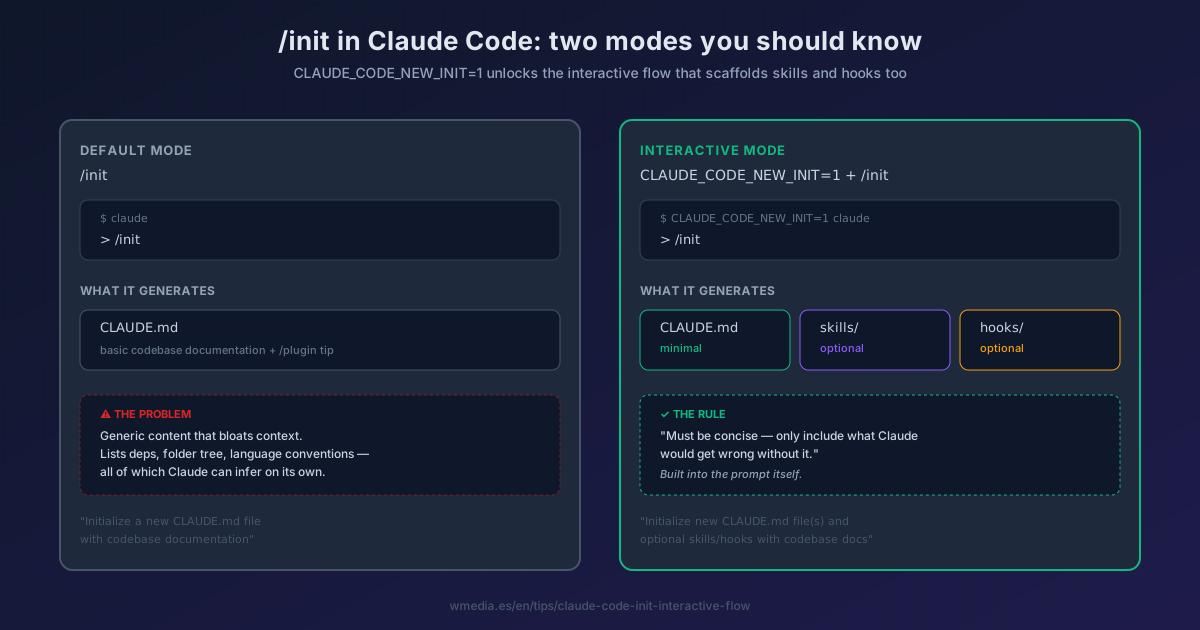
/init is one of those built-in commands almost everyone runs once on day one and never again. And they're stuck with the poor mode: a generic CLAUDE.md that Anthropic itself considers deprecated under its current philosophy ("CLAUDE.md is loaded into every Claude Code session, so it must be concise — only include what Claude would get wrong without it").
The new flow goes further: it can also generate the project's first skills and hooks. More importantly, it applies discipline on CLAUDE.md from day one. If your CLAUDE.md is already full of junk, re-running /init with the new flow is the cleanest way to start over.
How it works internally
When you run /init, Claude Code loads one of two prompts depending on CLAUDE_CODE_NEW_INIT:
| Mode | Variable | Description | What it generates |
|---|---|---|---|
| Default | (unset) | "Initialize a new CLAUDE.md file with codebase documentation" | Basic CLAUDE.md + note about /plugin |
| New | CLAUDE_CODE_NEW_INIT=1 |
"Initialize new CLAUDE.md file(s) and optional skills/hooks with codebase documentation" | Minimal CLAUDE.md + skills (optional) + hooks (optional) |
The new mode is governed by a literal rule in the prompt: "CLAUDE.md is loaded into every Claude Code session, so it must be concise — only include what Claude would get wrong without it." That means: don't list package.json dependencies, folder structure, or language conventions — Claude infers those.
How to enable it
For a single session:
CLAUDE_CODE_NEW_INIT=1 claude
Then inside the session:
/init
Permanently in your shell:
echo 'export CLAUDE_CODE_NEW_INIT=1' >> ~/.zshrc
When to re-run it
/init is not "once and forget":
- Major refactor: if you moved code to a monorepo, switched frameworks, or introduced new skills, re-init so CLAUDE.md and the hooks reflect the new state.
- After removing deprecated code: if your CLAUDE.md describes a module that no longer exists, regenerating is cleaner than patching.
- Before onboarding: a clean CLAUDE.md on day one shortens the ramp for new developers.
Bonus: /init-verifiers
There's a sibling command almost nobody knows about:
/init-verifiers
Generates skills specifically for automated verification of code changes. Useful when you want certain checks (linter, specific tests, type validation) to run consistently as auto-invocable skills after each edit.
Reference
| Command | Use it for |
|---|---|
/init (default) |
Basic CLAUDE.md generated from automatic analysis |
CLAUDE_CODE_NEW_INIT=1 + /init |
Minimal CLAUDE.md + skills + hooks |
/init-verifiers |
Post-edit verification skills |
Official docs: Claude Code commands