TL;DR Install the
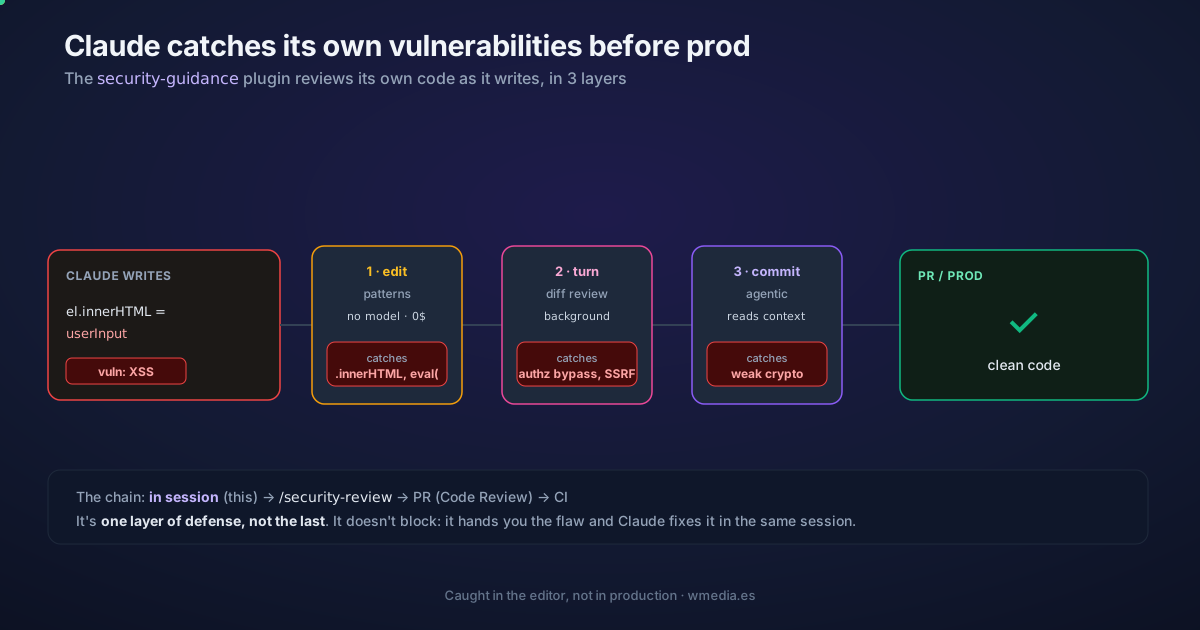
security-guidanceplugin (/plugin install security-guidance@claude-plugins-official) and Claude reviews its own code for vulnerabilities as it writes, in three layers: a per-edit pattern match, an end-of-turn diff review, and a deeper review on every commit. It catches injection, authz bypass, unsafe deserialization, weak crypto, and hands them to Claude to fix in the same session, before the PR. It runs on its own and never blocks: it's one layer of defense, not the only one.
security-guidance doesn't ask Claude to grade itself. It runs an independent review (a separate instance, fresh context, security-focused prompt) over what Claude just wrote. It's the earliest layer in the chain: it catches the flaw in the editor, before it reaches the PR, the review, and CI. Catch it here and it never ships to prod.
The three layers
| When | What it does | Cost |
|---|---|---|
| On each edit | Pattern match for risky calls: eval(, pickle, dangerouslySetInnerHTML, .innerHTML =, edits under .github/workflows/ |
0, no model call |
| At end of turn | Background review of the turn's diff: injection, authz bypass, IDOR, SSRF, weak crypto | Model usage |
| On each commit/push Claude makes | Agentic review that reads surrounding code (callers, sanitizers) to cut false positives | Model usage |
If it finds something, it re-prompts Claude with the finding and Claude fixes it in the conversation. You see the problem and the fix in your session, not in an after-the-fact report.
How to turn it on
# In a Claude Code session:
/plugin install security-guidance@claude-plugins-official
/reload-plugins
Pick user scope so it loads in every local session. For a shared repo (or Claude Code on the web, where user plugins don't carry over), declare it in .claude/settings.json:
{ "enabledPlugins": { "security-guidance@claude-plugins-official": true } }
From there it runs on its own. No command to remember.
Tune it to your project
- Natural-language rules for the model-backed reviews, in
.claude/claude-security-guidance.md. Your threat model: "every route under /admin must callrequire_rolebefore any DB read". How to teach it your threat model in depth. - Deterministic patterns per edit, in
.claude/security-patterns.yaml: your own regex or substrings, for example catching a hardcodedsk_live_. How to write those rules in depth (and for free, zero tokens).
Where it fits (and what it isn't)
It's one layer of defense in depth, not a complete solution: the reviewer model can miss things, and no layer blocks the commit. The full chain:
security-guidance, in session (this)/security-review, on demand when you ask/code-reviewlocally over your diff, before you open the PR- Code Review /
/ultrareview, on the PR - Your CI: static analysis, supply-chain scanners
Each stage catches what the previous one missed. This plugin's value is shrinking what reaches the later ones, not replacing them.
Watch out for
- It doesn't block. Findings arrive as instructions; Claude fixes them, but the final call is yours.
- It needs git for the turn and commit reviews. Without a repo, only the pattern match runs.
- It costs tokens on the turn and commit layers (the per-edit one is free). Capped at 20 commit reviews per hour.
- It needs Python 3.8+ on your
PATH; the first run creates a venv under~/.claude/security/. - The model-backed reviews use a strong model by default, configurable via
SECURITY_REVIEW_MODELandSG_AGENTIC_MODEL.
Reference
| Aspect | Detail |
|---|---|
| Install | /plugin install security-guidance@claude-plugins-official + /reload-plugins |
| Requirements | CLI v2.1.144+, Python 3.8+, git (for turn/commit) |
| Layers | edit (patterns) · turn (diff) · commit (agentic) |
| Custom rules | .claude/claude-security-guidance.md · .claude/security-patterns.yaml |
| Disable layers | ENABLE_PATTERN_RULES=0 · ENABLE_STOP_REVIEW=0 · ENABLE_COMMIT_REVIEW=0 · SECURITY_GUIDANCE_DISABLE=1 |
| Built on | hooks (PostToolUse, Stop…) |
Official docs: Catch security issues as Claude writes code