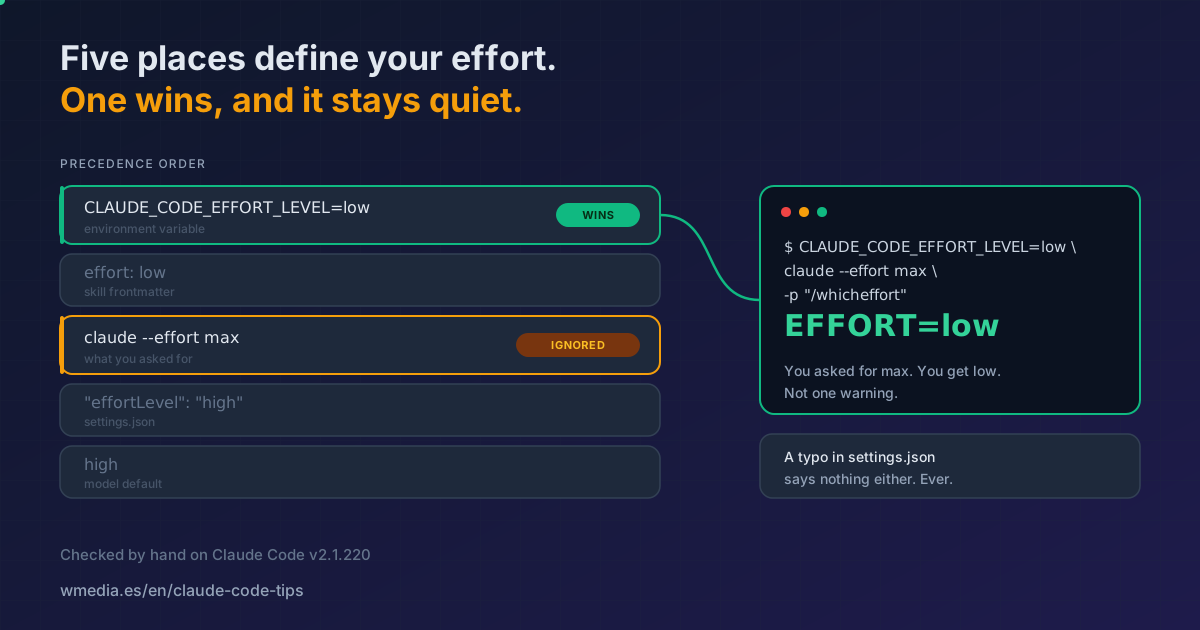
TL;DR Five places define your effort level and only one wins. The environment variable overrides even the flag you launched with, and it does it silently. An
effortLevel: "max"in yoursettings.jsonis ignored outright. The only way to read the real level from a script is a six-line skill using${CLAUDE_EFFORT}. The precedence chain is checked by hand, row by row, on v2.1.220.
Open your ~/.claude/settings.json. If it says "effortLevel": "high", you assume you're working at high.
Maybe you are. There are four ways you aren't, and not one of them says a word.
Here's what happens when you launch asking for the highest level there is:
$ CLAUDE_CODE_EFFORT_LEVEL=low claude --effort max -p "/whicheffort"
EFFORT=low
You asked for max explicitly, in the command itself. You're running at low. No warning, no line in the header, nothing. (/whicheffort is a six-line skill we build at the end of this tip; it's the only way to get that number out.)
The five places, and who beats whom
Effort doesn't live in one place. It lives in five, in this order:
| Where it's set | Scope | Beats |
|---|---|---|
CLAUDE_CODE_EFFORT_LEVEL |
The session | Absolutely everything |
effort: in a skill or subagent's frontmatter |
While that skill runs | Everything but the variable |
/effort and the --effort flag |
The session (persists, except max) |
Settings and the default |
effortLevel in settings.json |
Permanent | Only the default |
| The model default | When nothing else applies |
One correction since this tip went out: as of v2.1.251 that effortLevel in settings has a neighbour that beats it, each model's entry under modelSettings, which /effort writes on its own when you confirm a level with Enter, and as of v2.1.292 a subagent's effort: frontmatter gives way to the level Claude passes it at launch.
I tested all five rows one by one. Two results that aren't obvious: a skill's effort: frontmatter beats the flag you launched the session with (--effort max with a skill set to low runs at low), but the environment variable beats the frontmatter in turn. It's the same mess you get with the model, under its own rules: if yours sticks or resets on you, that's a separate story.
The four silent failures
1. The typo in your settings.
$ claude --settings '{"effortLevel":"hight"}' -p "/whicheffort"
EFFORT=high
I wrote hight. Not a word of warning. It falls back to the default and carries on. Compare that to the flag, which does validate what you hand it:
$ claude --effort bananas -p "hello"
Warning: Unknown --effort value 'bananas' — ignoring it and using the default effort.
Valid values: low, medium, high, xhigh, max.
The flag shouts. The file swallows it.
2. max in settings isn't a thing.
$ claude --settings '{"effortLevel":"max"}' -p "/whicheffort"
EFFORT=high
effortLevel only accepts low, medium, high and xhigh. Both max and ultracode are session-only and aren't accepted there. If you wrote it months ago convinced you were running flat out, you've been on high ever since.
3. The environment variable beats everything, including your flag. That's the example up top. Export it once in your .zshrc for an experiment and it still rules every session you open today.
4. max doesn't survive closing the terminal. Set low, medium, high or xhigh in an interactive session and they persist. max is the exception: it lasts that session and it's gone, unless you pin it through the environment variable. As of v2.1.257 the rest can be scoped too: Enter saves the level for that model and s keeps it to that session only. And if all you want is one deeper turn without touching any level, that's ultrathink.
There's a fifth case, and that one you already know about: starting on Fable 5, Opus 4.8 or Opus 4.7 imposes that model's default even when you had another level set.
Of every surface, exactly one tells you the truth when something is overriding it:
$ CLAUDE_CODE_EFFORT_LEVEL=low claude -p "/effort max"
Not applied: CLAUDE_CODE_EFFORT_LEVEL=low overrides effort this session, and max is session-only (nothing saved)
Two warnings in one line, and it's the only line that gives them.
How to read the real level, scripts included
Interactively, the level sits in the session header next to the model. Outside that you're blind: /status isn't available in headless, and --output-format json hands you the model, the cost to the cent, the cache tokens and even whether fast mode is off, yet says nothing about effort.
The way out is a context variable almost nobody uses. Create .claude/skills/whicheffort/SKILL.md:
---
name: whicheffort
description: Report the active effort level
---
Reply with exactly this line and nothing else:

EFFORT=${CLAUDE_EFFORT}
Now you have a probe that works the same in your terminal and in CI:
$ claude -p "/whicheffort"
EFFORT=high

$ claude --effort ultracode -p "/whicheffort"
EFFORT=xhigh
That second result is worth a look: ultracode isn't an effort level, so it reports as xhigh, which is what actually reaches the API. I used this same probe to confirm the effort of five configurations before benchmarking Opus 5.5 against Fable 5.1 and Opus 5.
What's at stake when the level isn't what you think
If this only changed how much Claude thinks, it would be a billing problem, and a heavy one: thinking is billed as output, and an output token runs about five times an input one. But it's more than that. Per Anthropic's docs, lowering effort reduces all the tokens in a response, and that includes tool calls: Claude batches operations together, makes fewer calls, goes straight to work without explaining the plan and confirms in a couple of words.
In practice: with effort lower than you believed, Claude edits your code having read fewer of your files. It isn't thinking worse, it's looking at less before it writes.
Which is why it pays to check once and forget, rather than fiddling with it. On Opus 5.5, raising it above medium didn't improve a single one of my tasks. Picking a level is already settled in how to adjust the effort level and in my routing across Sonnet 5, Opus 5 and Fable 5. And if you got here trying to spend less, effort is one front out of ten: the other nine are here.
Sonnet 5.5 falls into the same case as Opus 5.5: with "effortLevel": "high" in my user settings.json, the probe returns EFFORT=medium (measured here).
Reference
| Surface | Persists? | Warns on failure? | Takes max |
|---|---|---|---|
CLAUDE_CODE_EFFORT_LEVEL |
While it's exported | No | Yes |
effort: in frontmatter |
Only while the skill runs | No | Yes |
/effort |
Yes, except max |
Yes, the only one that does | Yes, that session |
--effort at launch |
That session only | Yes, on an unknown value | Yes |
effortLevel in settings |
Yes | No | No, it ignores it |
modelSettings.<model>.effortLevel |
Yes, and it beats the global effortLevel |
No | No |
If all of this suggests effort is a knob that matters, that's because it's the only one still wired to anything. And the global effortLevel row has an exception since Opus 5.5: in user settings it no longer reaches newer models, which start at their own default.
Official docs: Model configuration: adjust effort level · Effort · Skills: frontmatter
Requirements
- Checked on Claude Code v2.1.220. The
${CLAUDE_EFFORT}variable is available inside skills.