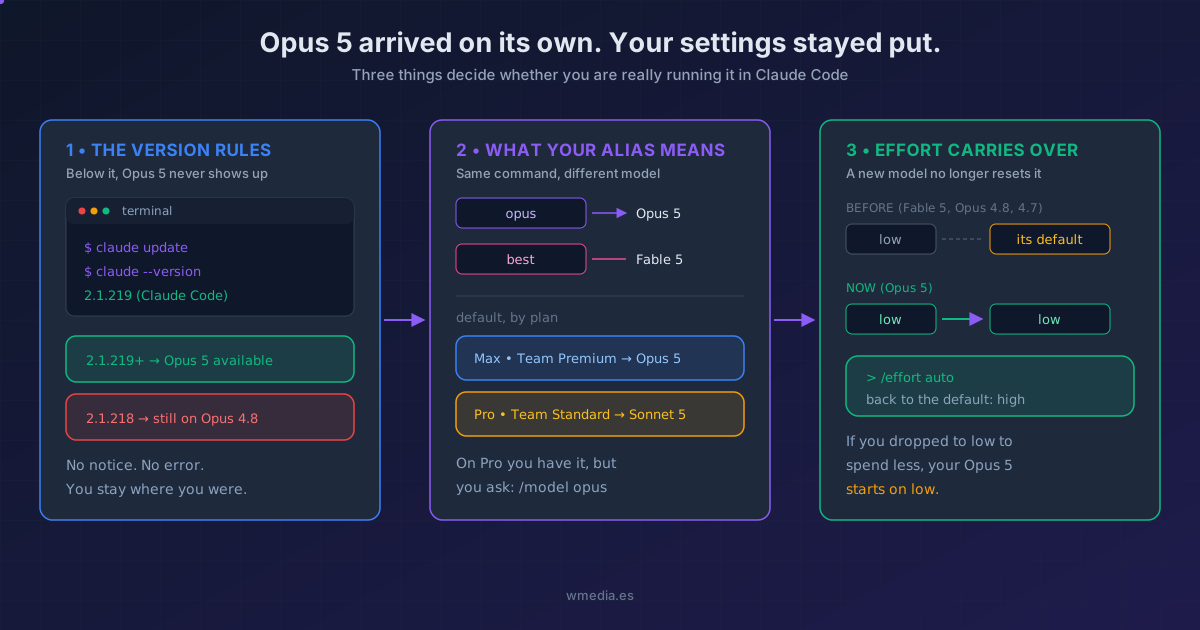
TL;DR Opus 5 shipped on July 24, 2026 and it's already in Claude Code. It needs v2.1.219 or later: below that, it doesn't even show up. The
opusalias anddefaultresolve to Opus 5 on Max, Team Premium, Enterprise pay-as-you-go, and the API, but on Pro and Team Standard your Default is still Sonnet 5. Same price per token as Opus 4.8 ($5/$25 per MTok) at a clearly lower cost per task. And the detail almost nobody will check: Opus 5 doesn't reset your effort, it carries over whatever level you had set.
Update, September 22, 2026: Opus 5.5 replaces Opus 5 as the Default, on Pro and Team Standard too, and needs v2.1.280. And unlike Opus 5, it doesn't carry your effort over: it starts at
mediumuntil you give it its ownmodelSettingsentry.
Model launches always get told the same way: benchmarks, price, one marketing line. What rarely gets told is the part that's actually yours, duller and more important: whether your terminal is in any shape to receive it, and which of your own settings still outrank the shiny new model.
Opus 5 is a good example. It arrives on its own, without you doing anything, and it may not reach you at all.
What it brings, briefly
Anthropic positions it on cost per task, not price per token (the per-token price is identical to Opus 4.8):
- Frontier-Bench v0.1: more than double Opus 4.8, at a lower cost per task.
- CursorBench 3.2: within 0.5% of Fable 5's peak score, at half the cost per task.
- OSWorld 2.0: above Fable 5's best result, at just over a third of the cost.
- ARC-AGI 3: three times the next-best model.
Two things show up while coding more than any table does: it verifies its own work with far less nagging from you, and there's much less variance run to run. On cybersecurity tasks it still trails Mythos 5, per the launch note itself.
How to find out where you stand
1. Update, or it doesn't exist
claude update
claude --version
# 2.1.219 (Claude Code)
Opus 5 requires Claude Code v2.1.219 or later. Below that version the opus alias keeps handing you Opus 4.8 and Opus 5 never appears in the picker. There's no warning: you simply stay where you were.
2. Check what your alias resolves to
As of v2.1.219, opus points to Opus 5 on the Anthropic API, Claude Platform on AWS, Amazon Bedrock, and Google Cloud's Agent Platform. On Microsoft Foundry it still resolves to Opus 4.6, so there you need the full name or ANTHROPIC_DEFAULT_OPUS_MODEL.
/model opus            # Opus 5 on the API and the main clouds
/model claude-opus-5   # pins the version and takes the alias surprises away
Watch out for best: it still resolves to Fable wherever your organization has access, and only falls back to the latest Opus when there's no Fable. best is not Opus 5. Since September 1, 2026 that best is Fable 5.1, which needs Claude Code v2.1.257 and changed the cost arithmetic you had worked out. If you're torn between the two, Fable is still the model above Opus for long, hard tasks, but Opus 5 gets close on code at half the cost. And if you're never quite sure which model for what, the choose-your-model guide is up to date.
3. Effort doesn't reset (this part is new)
Until now, switching to a new model reshuffled your effort: the first time you ran Fable 5, Opus 4.8, or Opus 4.7, Claude Code applied that model's default level even if you had set another one, and held it across sessions until you made an explicit choice.
Opus 5 has no such hold: the level you had set carries over. If you once dropped to low to spend less, your brand-new Opus 5 starts on low. The model's own default is high.
/effort         # opens the slider and shows the active level
/effort auto    # back to the model default (high on Opus 5)
The active level also appears in the session header next to the model (the docs illustrate it with a with low effort), so it's one glance, no menus. If /effort means nothing to you, here's the full detail.
4. On Pro, it doesn't come to you
default depends on your account type:
- Max, Team Premium, Enterprise pay-as-you-go, and API: Opus 5.
- Pro, Team Standard, and per-seat Enterprise: Sonnet 5.
On Pro you do get Opus 5 as the strongest model on the plan, but you ask for it yourself with /model opus. If that difference has you second-guessing your plan, I wrote which one you actually need after using them all.
The warning worth reading before a CTF
Opus 5 runs with cybersecurity and biology safety classifiers. When one fires, the two cases don't behave the same:
- Cybersecurity: the request is rerouted to Opus 4.8, with a notice in the transcript.
- Biology: there is no fallback model. Opus 5 runs its own biology classifiers and the request ends in a refusal.
Pentesting work, CTFs, or repos with biology-adjacent code trigger this often, frequently on the very first request. It's the same mechanism Fable 5 came back with, and it has nothing to do with the availability fallback chain: one reroutes on content, the other on a 529.
Reference
| Setting | Resolves to |
|---|---|
opus (API, AWS, Bedrock, Google Cloud) |
Opus 5 |
opus (Microsoft Foundry) |
Opus 4.6 |
best |
Fable 5.1 where you have access (v2.1.257+), otherwise the latest Opus |
default on Max / Team Premium / Enterprise pay-as-you-go / API |
Opus 5 |
default on Pro / Team Standard / per-seat Enterprise |
Sonnet 5 |
opus[1m] |
Opus 5 with a 1M-token context window |
| Opus 5 | Detail |
|---|---|
| Price | $5 input / $25 output per MTok (same as Opus 4.8) |
| Fast mode | 2x base price, around 2.5x the speed |
| Effort levels | low, medium, high, xhigh, max (default high) |
| Effort on first run | Carries yours over (Fable 5, Opus 4.8, and 4.7 imposed theirs) |
| Minimum version | Claude Code v2.1.219 |
Official docs: Model configuration · Introducing Claude Opus 5
Already running it? The next step is Anthropic's 8 tips for using it: half of them are instructions to remove from your
CLAUDE.md, starting with the verification ones. About to leave it running on its own for a while? Ask for chained tasks with their dependencies first: that's where you see how it split the work, and whether it started delegating more than it should. When Opus and when one of the other two? My actual routing, and what switching models mid-session costs: Sonnet 5, Opus 5 and Fable 5. And if it carries your level over, the question is which level: five places define it and four fail silently (the whole chain). That level is also saved per model: Opus 5 keeps its own and every other model keeps theirs.
Requirements
- Claude Code v2.1.219 or later (
claude update). On Microsoft Foundry theopusalias won't reach it: use the full nameclaude-opus-5orANTHROPIC_DEFAULT_OPUS_MODEL.