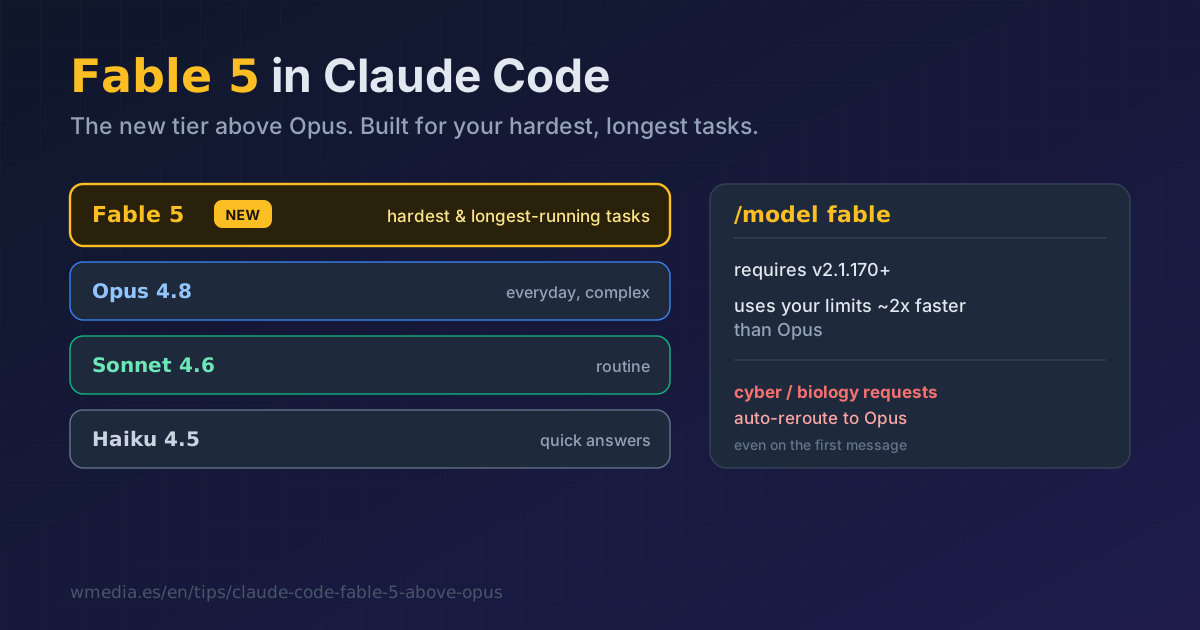
TL;DR Fable 5 is Claude Code's new ceiling, above Opus: built for your longest, hardest tasks. Switch to it with
/model fable(you need v2.1.170 or later). It burns through your limits ~2× faster than Opus, so it isn't for everything. And it ships with a safety classifier that can reroute you to Opus on its own, sometimes on the very first message.
The model picker just went from four options to five. Fable 5 sits above Opus as the most capable model: built for tasks that don't fit in a single sitting. It investigates before acting and verifies its own work more than smaller models do. It isn't the default: your account still starts on Opus (or Sonnet, depending on your plan), and you step into Fable on purpose.
Result:
Select model

  1. Default (recommended)   Opus 5 with 1M context
> 2. Fable 5                 Most capable for your hardest and longest-running tasks
                             Uses your limits ~2× faster than Opus
  3. Sonnet                  Sonnet 5 · Efficient for routine tasks
  4. Haiku                   Haiku 4.5 · Fastest for quick answers
  5. Opus 5 ✓                Best for everyday, complex tasks (claude-opus-5)

Enter to set as default · s to use this session only
1. How to switch
/model fable, or pick option 2 in the picker (/model with no argument). In the picker, Enter makes it your default for new sessions and s uses it for this session only. That change (Enter saves the default, s is session-only) has its own tip. The best alias points to Fable 5 wherever your account has access, so best is never Opus while you still have Fable.
2. The requirement (it just shipped)
Fable 5 needs Claude Code v2.1.170 or later. If your picker doesn't show it, run claude update. It isn't available under zero data retention: there the picker omits it or shows it disabled.
3. When it's worth it
The docs are blunt about how to get the most from it, and most of it runs against your reflexes from smaller models:
- Describe the outcome, not the steps. Hand it the result you want and let it plan the path. Pair it with
/goalto keep it working until that outcome holds. And to describe that outcome with confidence, understand what you delegate first. - Hand it ambiguous problems: root-cause investigations, outage debugging, architecture decisions. That's where the extra investigation pays off.
- Stop reminding it to test: it verifies its own work with less prompting, so the "remember to check this" nudges are usually wasted.
- Size up larger tasks: work you'd normally break into pieces. It holds long sessions without losing the thread.
Effort is high by default, up to max. On Fable 5 thinking can't be turned off: it always reasons adaptively, and the switches that would turn it off on other models (Option+T, alwaysThinkingEnabled, MAX_THINKING_TOKENS=0) do nothing here.
That permanent reasoning has a visible side effect you won't get on any other model: Fable slips in a (summarized) line telling you what it is about to do right before it does it, and it shows with nothing switched on.
And because its autonomous runs stretch for hours, the docs recommend checking on them asynchronously rather than sitting there watching. For that, before you let the work go, ask for chained tasks with their dependencies: the graph shows you how it split the work, and you can audit it in thirty seconds.
And once Fable has scoped the ground and you want to drop to Opus for the bulk, mind the order: compact before you switch models, not after. Why, and when dropping is worth it.
4. The automatic reroute nobody warns you about
This is the most practical part and almost nobody will see it coming. Fable 5 runs with safety classifiers for cybersecurity and biology. When one flags your request, Claude Code re-runs it on Opus with a notice, and the session continues there. As of Claude Code v2.1.219 the destination depends on the category: biology-flagged requests re-run on Opus 5, cybersecurity-flagged ones on Opus 4.8. To get back: /model fable.
The surprising bit: it can trigger on the first message, before you've typed anything unusual, because that first request carries your CLAUDE.md and the repo's git status. A repository with security or biology material can trip it on that context alone.
- To check whether your customizations are the trigger, start in safe mode with
claude --safe-mode: it disables CLAUDE.md, skills, MCP, and hooks. Git status and directory names still count. - To decide each time instead of letting it switch on its own, go to
/configand turn off "switch models when a message is flagged".
If you work in pentesting, CTF, or biology-adjacent code, expect it to fire often. Note: this reroute is content-based. The availability one (when your model is overloaded with a 529 or down) is a different mechanism: fallbackModel chains.
Update (Jul 2026): Fable 5 was suspended from June 12 to July 1 and came back with a stricter classifier that now fires on routine code too. What happened and what to do: Fable 5 is back in Claude Code.
Fable 5 at a glance
| How to switch | /model fable · picker option 2 · best alias |
| Default | No (you stay on Opus 5 or Sonnet) |
| Minimum version | Claude Code v2.1.170 |
| Limits | burns them ~2× faster than Opus |
| Effort | high by default, up to max · thinking always on |
| Context | 1M tokens on the Anthropic API |
| Safety fallback | biology → Opus 5 · cybersecurity → Opus 4.8, with a notice |
Where it fits
Fable 5 is the new tier above Opus 4.7 and every Opus since. As of July 24, 2026 that neighbour is Opus 5, which gets close on code at half the cost per task and beats it on OSWorld. If you're unsure what to use when, the choose-your-model guide still holds: Fable for the hardest, longest work, Opus for everyday, Sonnet 5 for routine, Haiku for quick answers.
Official docs: Model configuration | Introducing Claude Fable 5
Requirements
Claude Code v2.1.170 or later (claude update). Not available under zero data retention.