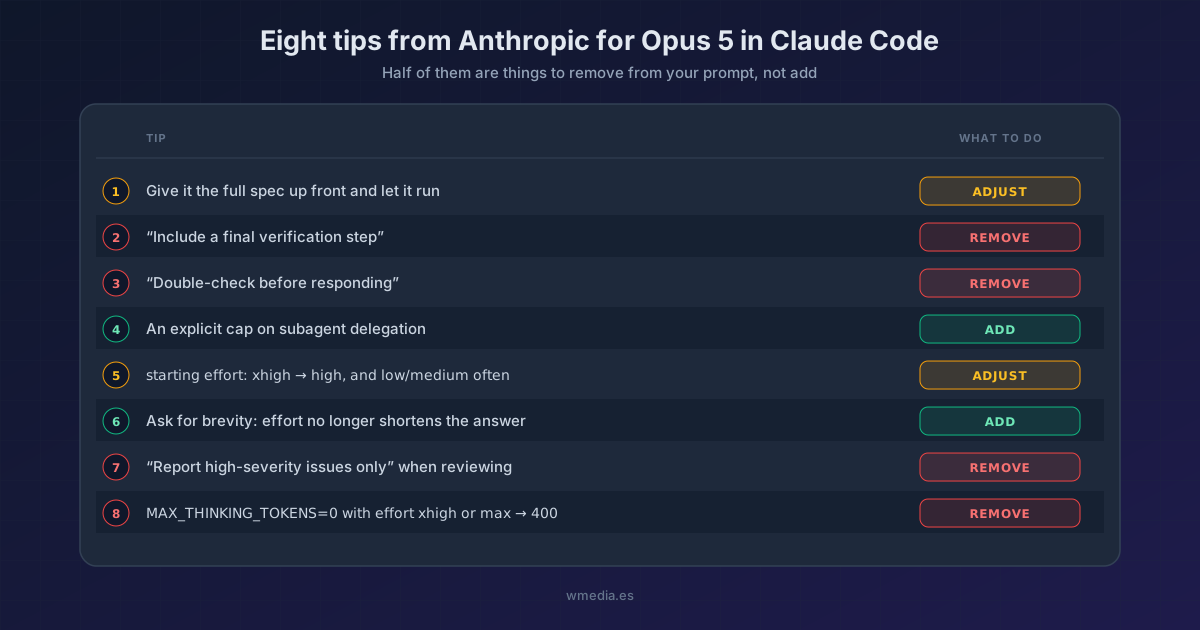
TL;DR Alongside Opus 5, Anthropic published a model-specific prompting guide. The interesting part is that half the advice is about what to remove, not add: the verification instructions, the double-check lines, and the effort level you inherited from Opus 4.8. Here are all eight, translated into the things you actually touch in Claude Code.
Everyone read the launch post. Almost nobody read the other page Anthropic published the same day: the Opus 5 prompting guide. That's the one that actually changes how you use it, because it isn't a list of generic best practices. It's a list of behaviors that changed since Opus 4.8, with what to do about each.
If what you want is to know whether Opus 5 has reached you at all (minimum version, alias, plan), that's in the launch tip. This is the next step: what to do differently once it's in front of you.
1. Give it the whole task up front, and fence the scope
Opus 5 does best when you hand it the complete task specification up front and leave it to run, rather than feeding it step by step. It finishes whole tasks instead of leaving stubs. The counterweight: it also expands tasks on its own, adding steps you didn't ask for. One prompt handles both.
Deliver what was asked, at the scope intended. Make routine judgment calls
yourself, and check in only when different readings of the request would lead to
materially different work. If the request seems mistaken, say so in a sentence
and continue with the task as asked.
For the part about writing that request well, the five prompt rules Anthropic actually follows still hold. And to check it understood the spec before you let it run, ask for chained tasks with their dependencies: the graph shows you how it split the work in thirty seconds.
2. Delete the verification instructions
This is the one most people have written down somewhere, and the least intuitive. The guide doesn't hint, it instructs: if your prompt (or your CLAUDE.md) asks for a final verification step or a subagent to verify, remove it. It causes over-verification, and removing it cuts wasted tokens with no loss in quality.
grep -rns -i "verify\|double-check\|re-check" \
  ~/.claude/CLAUDE.md ./CLAUDE.md ./.claude/agents/ ./.claude/skills/
Custom agents and skills are the favorite hiding spot: written once, working fine, never opened again. If your CLAUDE.md hasn't been touched in months, now is a good moment.
3. Don't ask it to double-check either
Same family: "review your answer," "re-verify before responding." Opus 5 catches and fixes its own mistakes unprompted, so the instruction doesn't add a safety net. It duplicates the one already there.
What is worth telling it is when to keep those corrections quiet, since it narrates them more than earlier models: only correct an earlier statement when the error would change the user's code, conclusions, or decisions.
4. Cap the subagent delegation
Opus 5 coordinates teams of subagents well, and that is exactly why it reaches for delegation more readily. It pays off on genuinely large work and multiplies cost and time on everything else.
Delegate to a subagent only for large tasks that are genuinely independent and
parallelizable. Don't delegate work you can finish in a handful of tool calls,
and don't use subagents to verify your own work. If one will do, use one.
The same line belongs inside each agent you keep in .claude/agents/. And if you live in workflows with hundreds of agents, there the cap comes from the script, not the model.
5. Reach for low and medium freely
A reversal from Opus 4.7 and 4.8, where the advice was to start at xhigh for coding. On Opus 5 you start at high (the default) and use low and medium liberally as your primary control for cost and latency. xhigh is for the demanding work.
And watch out, because Opus 5 doesn't reset your effort when you switch to it: the level you pinned months ago is still there. If it lives in settings.json or the environment variable, that's where to go looking.
6. Brevity has to be asked for separately
Opus 5 answers at greater length than previous Opus models, and here's the wrinkle that breaks the intuition: effort controls how much it thinks, not how much it says. Lowering it reduces reasoning without reliably shortening what lands on your screen.
Keep responses focused, brief, and concise. Keep disclaimers and caveats short,
and spend most of the response on the main answer. Match the length of documents
you write to what the task needs, without filler sections.
Files it writes to disk (reports, summaries, docs) also run longer than they used to, hence the second sentence. In a long CLAUDE.md, repeat the short version near the end.
7. In review, don't say "high severity only"
Opus 5 reviews code with high precision and finds real bugs at a good rate. But it follows instructions literally: if your review prompt says "only report high-severity issues" or "be conservative," it reports less. The guide's advice is to ask for everything and filter in a separate pass.
That plugs straight into /code-review locally, where accuracy also holds up at lower effort: a fast pass while you write, a deeper one before the PR.
8. If you turned thinking off, check that first
The guide closes with the artifacts that show up when thinking is disabled (tool calls written out as plain text, internal XML tags leaking into the visible answer). In Claude Code that only reaches you if you once set MAX_THINKING_TOKENS=0 in your settings.json. And if that's you, there's something more urgent than the artifacts:
$ MAX_THINKING_TOKENS=0 claude -p "hi" --model opus --effort xhigh
API Error: 400 output_config.effort 'xhigh' is not supported when
thinking is disabled on this model. Use effort 'high' or below, or
enable thinking.
On Opus 5 thinking cannot be disabled above high, so that combination doesn't degrade, it breaks. At high or below it answers normally, and the same combo on Opus 4.8 runs without error. The underlying advice is the same either way: leave thinking on and control spend by lowering effort, because thinking at low beats not thinking at similar cost.
And if your plan was to trim spend by capping the budget rather than switching thinking off entirely, that door is shut too: on Opus 5 and every other adaptive model, any MAX_THINKING_TOKENS value other than 0 is ignored.
Reference
| Tip | On Opus 4.8 | On Opus 5 |
|---|---|---|
| Full spec up front | Helped | Does better still if you also let it run |
| "Verify at the end" | Useful | Redundant: over-verification |
| "Double-check" | Useful | Redundant: already self-corrects |
| Subagent delegation | Rare | Delegates more on its own, cap it |
| Starting effort | xhigh for coding |
high, with low and medium often |
| Response length | Effort shortened it | Ask for it separately |
| "High severity only" in review | Filtered | Reports less than it sees |
MAX_THINKING_TOKENS=0 + xhigh |
Works | 400 on every request |
Official docs: Prompting Claude Opus 5 · Effort
Already on Fable 5.1? Its guide has sixteen sections and Claude Code ships six of them built in; the three it leaves out go in your CLAUDE.md.
On Opus 5.5? One command checks your
CLAUDE.mdand skills for rules written for older models:/claude-api prompt-auditflags each one and writes the patch.
Requirements
- Claude Code with Opus 5 active (
/model opus), which needs v2.1.219 or later. Checked on v2.1.220. - On Opus 4.8 or earlier, change nothing: the advice above describes behaviors only Opus 5 has.