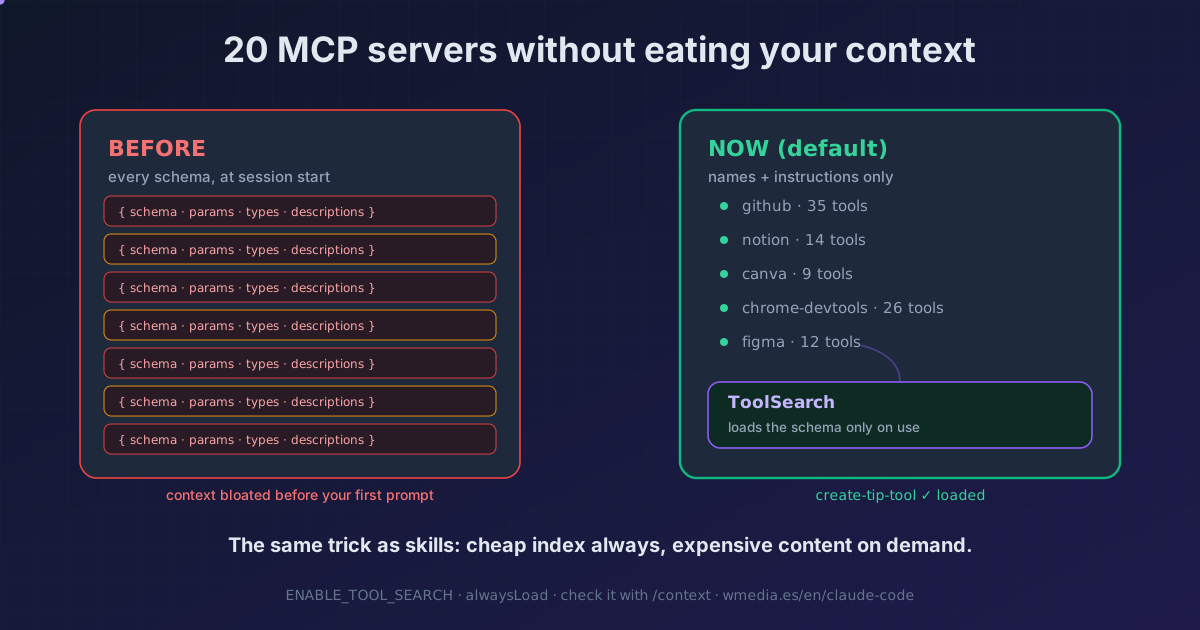
TL;DR Your MCP tools no longer load at session start: they're deferred, and Claude looks them up with an internal tool (
ToolSearch) only when it needs them. At launch, only tool names and one instruction per server enter context. It's the same trick you already know from skills, applied to MCP. It's on by default, and you tune it withENABLE_TOOL_SEARCHif you want different behavior.
For months the rule was five servers is enough, fifty just slows the agent down: every MCP dumped the full definitions of all its tools into context at startup, and connecting GitHub + Notion + Chrome DevTools cost you tens of thousands of tokens before you typed your first word. Tool Search quietly changed that math, and almost nobody noticed because, from the outside, everything works the same.
The trick you already know (from skills)
Skills have always worked this way: only the name and a one-line description live in context; the full body loads when invoked. Progressive disclosure: a cheap index always visible, expensive content only when needed.
Tool Search applies that same pattern to your MCPs, and the docs make the comparison outright: "server instructions help Claude understand when to search for your tools, similar to how skills work."
| Skills | MCP tools (with Tool Search) | |
|---|---|---|
| Always in context | name + description | tool names + server instructions |
| Loaded on demand | the SKILL.md body | the full schema, via ToolSearch |
The same pattern reaches your project rules too: with .claude/rules/ and paths: frontmatter, each rule loads only when you touch matching files.
How it works
At session start, only the tool names and each server's instructions (truncated at 2KB) enter context. When Claude needs a specific tool, it calls ToolSearch (keyword search works, no exact name needed), the full schema enters context at that moment, and it uses the tool. Only the tools that actually get used cost context.
I see it daily: in the session where I'm writing this, there are about 90 deferred tool names (Notion, Canva, Chrome DevTools...) and Claude only loaded the schemas of the three it touched to publish. Before, all 90 schemas would have entered whole at startup.
Check it yourself with /context: the MCP tools category that used to dominate the window is now a fraction.
The knobs
It's on by default. To change the behavior, the ENABLE_TOOL_SEARCH variable (in your settings env block or at launch):
| Value | What it does |
|---|---|
| (unset) | Everything deferred, discovered on demand. The default |
auto |
Hybrid: if all tools fit within 10% of context, they load upfront; the overflow is deferred |
auto:N |
Same, with a custom threshold (0-100), e.g. auto:5 |
false |
The old behavior: everything upfront, no deferral |
true |
Forces deferral even on Vertex or behind a proxy |
And per server: if one should always be visible without a search step (because you use it every turn), exempt it with alwaysLoad in its configuration:
{
  "mcpServers": {
    "github": { "type": "http", "url": "https://api.githubcopilot.com/mcp/", "alwaysLoad": true }
  }
}
The fine print
- Haiku supports it too from Haiku 4.5 on (it requires models with
tool_reference: Sonnet 4.5, Haiku 4.5, Opus 4.5 and later). - Disabled by default on Vertex AI (supported from Sonnet 4.5 and Opus 4.5; force it with
ENABLE_TOOL_SEARCH=true). - It switches itself off if your
ANTHROPIC_BASE_URLpoints to a non-first-party proxy. - If you publish your own MCP server, the server instructions are now your storefront: write them like a skill's
description(what tasks your tools cover and when to search for them).
So is the rule of five dead?
The context half of that rule, yes. But curation still wins for two other reasons: every connected server still adds its names and instructions, and a giant menu of options still costs per-turn decisions. Connect the ones you use; the price of getting it wrong is just much lower now. And if you want to know which of the connected ones is actually costing you, the /usage breakdown splits your limit across your servers by name and percentage. When one gets stuck on "Failed to connect", follow the decision tree by transport. If the one you connect is simply slow, it no longer holds your turn either: at the two-minute mark the call moves to the background and you keep working. Cache bonus: with tools deferred, connecting or disconnecting a server mid-session no longer invalidates the prefix.
Where it does invalidate it is when you have given a server alwaysLoad, because then its schemas live in the prefix. And you can see that: /cost files it under likely cause: tool definitions changed, with the exact count of tools added and removed.
Official docs: Scale with MCP Tool Search
Requirements
On by default on the Anthropic API with Sonnet, Opus and Haiku. See the fine print for Vertex AI and proxies.